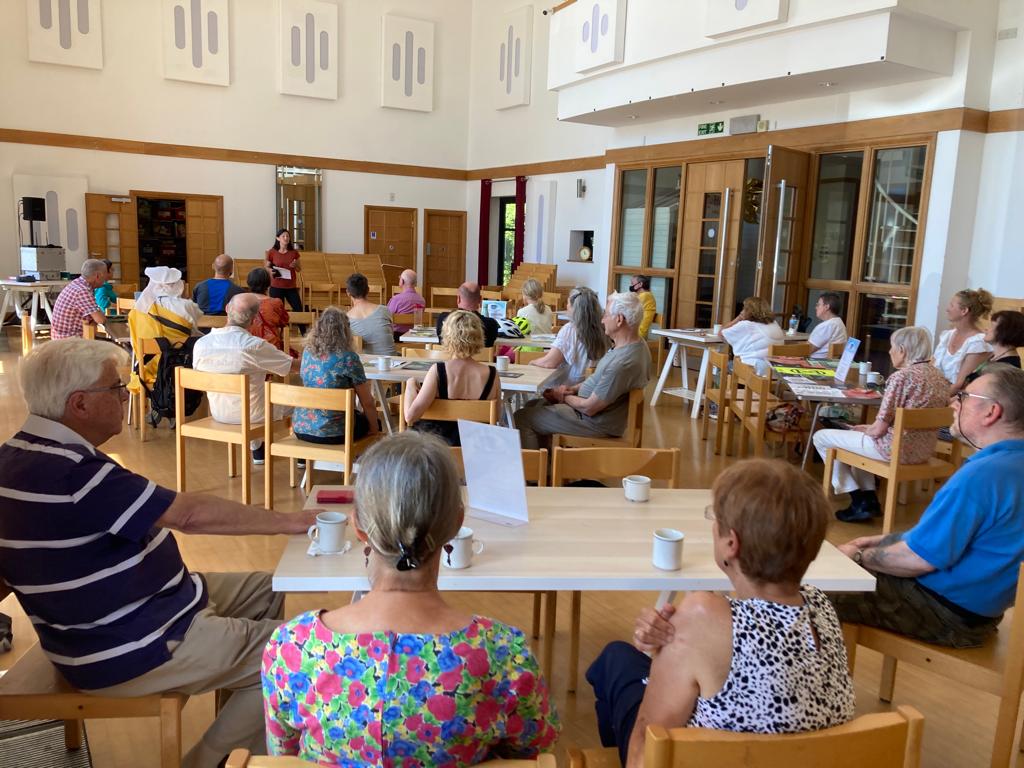
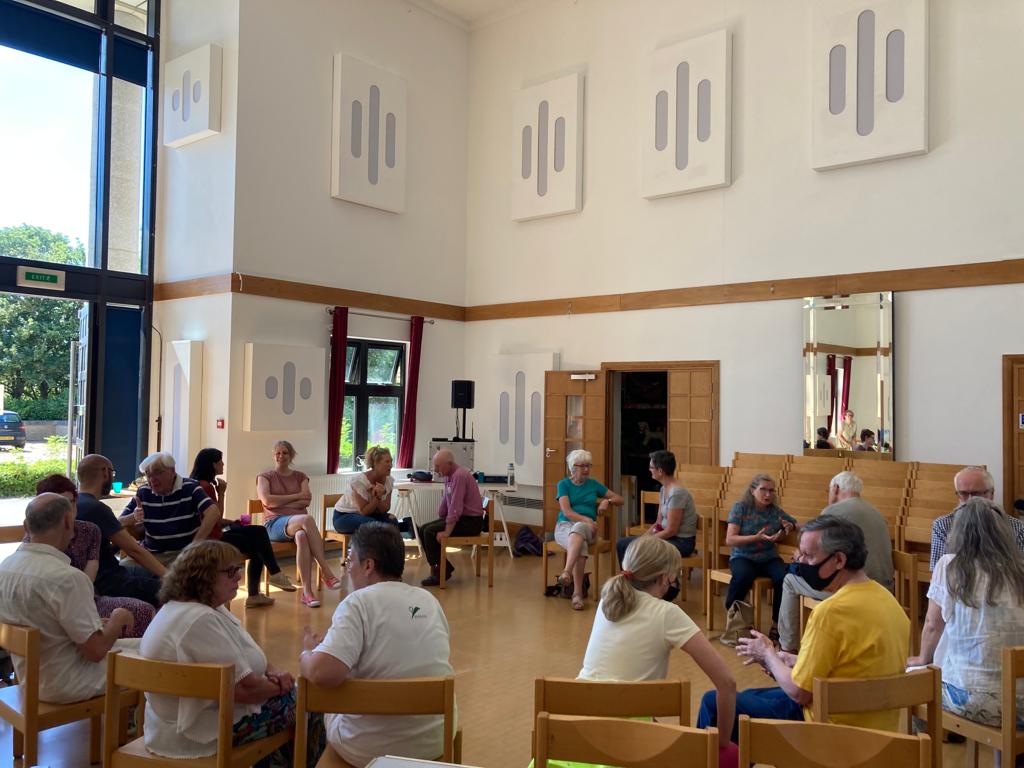
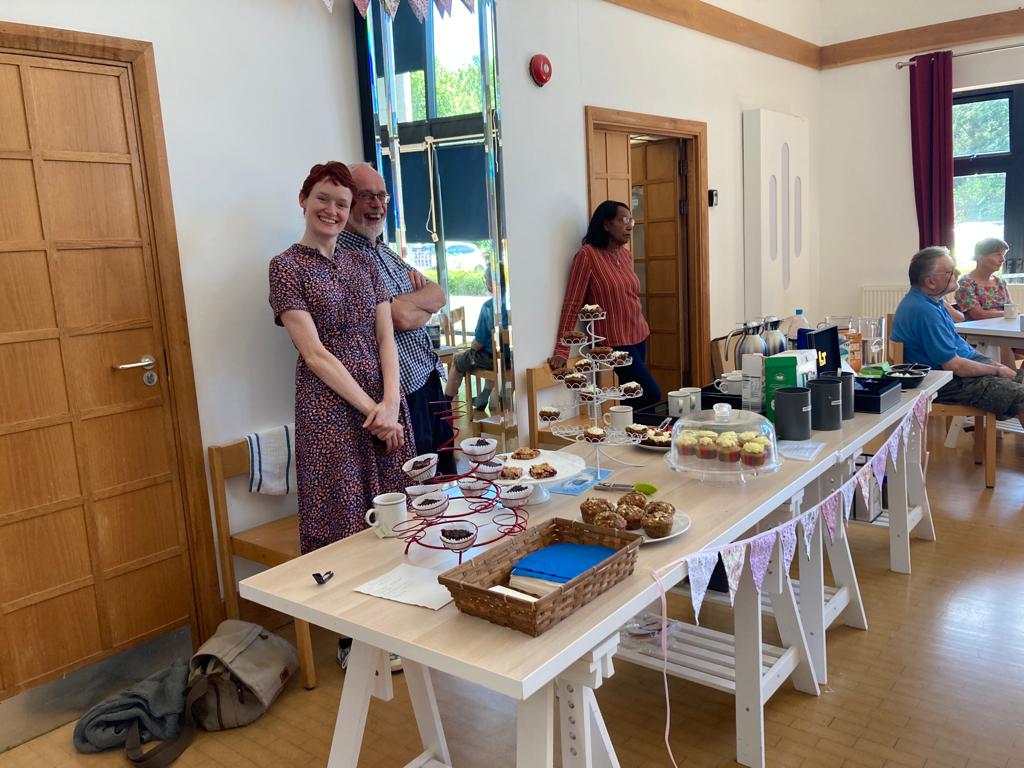
Our third Climate Cafe since relaunching was a great event at the Guildhall, Christ the Cornerstone Church, in the City Centre. It was the perfect location for our Cafe with homemade vegan cakes, engaging in a useful and interesting interactive circle and listening to our three inspirational speakers. Our theme was “Our Stories” and we shared what we are doing to address the climate emergency. Our speakers were: Rae Sibbitt on veganism; Alicia Pym on living off grid, and Debbie England on low-carbon living. See the transcripts of their speeches below:
How am I making a difference? – Rae Sibbitt
I went on a plant-based diet 5 years ago, aged 53, for health reasons. I already cooked a lot at home so it was easy and fun to learn to cook healthy meals from scratch. I then got interested in learning about veganism, and started reading about it and watching things that blew my mind, such as Joaquin Phoenix’s ‘Earthlings’1, ‘The Best Speech You Will Ever Hear’ by Gary Yourofsky2 and ‘Land of Hope and Glory: the Hidden Truth Behind UK Animal Farming’3. After seeing all this, as well as reading about the health benefits of a plant-based diet, I decided I wanted to be vegan, and wished I’d educated myself and done it years ago.
Although being vegan isn’t a diet – it’s just about not harming animals unnecessarily, for any reason – diet is a big part of it. What was really nice was learning that not only was I benefiting my health and living a compassionate life, but my plant-based diet was also better for the planet. It saddens me to feel that we are on an irreversible journey towards mass extinction, but I find it heartening that so many people are considering adopting a plant-based diet, actively taking responsibility for their own personal impact.
For anyone who is interested learning how a plant-based diet can reduce their environmental impact, I would recommend having a look at any of the following:
1. The World Wildlife Fund Environmental Footprint Calculator4 – encourages people to reduce their footprint by adjusting their diet, with a vegan diet having the lowest impact:
2. The documentary ‘Cowspiracy’ on Netflix shows the environmental impact of animal agriculture globally and how damaging and unsustainable it is e.g.
1,000 litres of water is used to make 1 litre of milk,
5.2 billion gallons of water consumed globally by humans per day, compared to 45 billion gallons consumed by cattle
21 billion pounds of food consumed globally by humans per day, compared to 135 billion pounds consumed by cattle
3. In 2018 a research paper5 by Poore and Nemecek at Oxford University showed how consuming meat and dairy, however local or ‘high welfare’, has a greater environmental impact than a plant-based diet. They conducted a meta-analysis of 38,000 farms across the world, looking at different types of farming, and reported on various aspects of environmental impact including: land use, water use (and impact on scarcity), greenhouse gas emissions, air pollution, water eutrophication (dead zones) and ocean acidification. Note for milk-drinkers: Oat milk and soya milk have the lowest environmental impact overall, while dairy has the highest.
4. The documentary ‘Seaspiracy’ on Netflix shows the impact of the global fishing industry – not only on our ocean life, marine populations and climate change, but also on the lives of those working in the industry.
There is so much research out there which additionally reports on the impact of animal agriculture on desertification, habitat and biodiversity loss, deforestation, antibiotic resistance, and of course global zoonotic pandemics. For reading I would especially recommend:
“Envirocidal: How livestock farming is killing the planet”, Viva, (2019) – a well-referenced report and a powerful read;
“Comfortably Unaware: What we choose to eat is killing us and our planet”, by Richard A. Oppenlander (2012);
“The Sustainability Secret: Rethinking our diet to transform the world”, by Kip Andersen (who directed Cowspiracy) and Keegan Kuhn.
And also, a great read by a former US dairy farmer:
“Mad Cowboy: Plain truth from the cattle rancher who won’t eat meat”, by Howard F. Lyman (1998).
A final thought on the argument that we need to control the human population if we don’t want to run out of food: there are 7.4 billion of us on this planet, all of us needing to eat food and drink water every day. However, we give precious food and drinking water to more than 70 billion land animals every year, that we deliberately breed, raise and then slaughter, for food that we don’t actually need. This makes no sense to me, especially given the situation we now find ourselves in.
There are lots of resources and support out there for people wanting to try moving to a plant-based diet. I would recommend having a look at Animal Aid https://www.animalaid.org.uk/veganism/why-veganism/going-vegan-environment/, or Veganuary (a 31-day supported programme for any month) https://veganuary.com/, or the free mentored programme Challenge 22 https://challenge22.com/. There is also our local friendly MK Vegans group on Facebook, always on hand for advice on healthy and also unhealthy plant-based eating!
Thank you for reading.
From consumer heroes to net zero heroes.
A decade of change
Alicia Pym
I’d like to tell you about how we went from being consumer heroes to net zero heroes. Like everything, it doesn’t happen overnight. This took a decade of change.
Back in 2012 we stumbled across a short film called The Story of Stuff. This details how products are made, the resources used and their impact on the environment.
This film prompted us to examine our own consumption and we realised things were out of control – we were essentially consumer heroes contributing massively to waste mountains and environmental damage and things had to change. A short animation by Steve Cutts, “MAN”, which details our obsession/addiction to excess was the nail in the consumerism coffin.
On 1st December 2012 we downsized from a 4 bedroom house, filled with Stuff, to a 64’ Narrowboat and sold or gave away at least 50% of our belongings. This was just the beginning of the journey.
By 2018 the impending climate crisis was starting to create headlines as Extinction Rebellion started to gain traction. The headlines began to shift our focus onto our overall environmental impact, taking into account greenhouse gas emissions and animal agriculture.
The average UK person is responsible for 12.7 tonnes of CO2 per year and by this point we were at around 9 tonnes per year each, but were now conscious that everyone needs to be at net zero if we are to sustain a habitable planet not just for future human generations but all Earth’s inhabitants.
By May 2019 we had started taking part in XR/Climate actions and made further decisions regarding our lifestyles. We were already vegetarian and had been for decades but became vegan after watching Earthlings, Cowspiracy, What The Health and Forks Over Knives – the animal agriculture industry is literally killing all the ecosystems as well as 80 billion animals in the UK alone each year, all of which suffer inhumane treatment, no matter how they are reared.
We have a installed a solar array on our narrowboat and moved out of the marina we had been living at (which had on-grid electric hook-up) and became completely off-grid. We get 100% of our electric from the sun between March and October. During the 4 darkest months (Nov-Feb) we get around 50% from the sun and do have to occasionally run a small petrol generator to top up our batteries. Our total spend on petrol was £30 last winter. Our bottled gas consumption for hot water and cooking is £70 a year. Our water usage is 75 litres a week each compared to UK average of 150 litres a day per person.
Another area in which we have made significant improvements is travel. We no longer fly (save for emergencies) and have 1 very small car, where previously we had 2 cars, one of which was highly polluting. Whilst still a fossil fuel vehicle our remaining car averages 50-60 mpg. Journeys of less than 5 miles are mostly done by foot, bicycle, e-bike and occasionally the e-scooters we have in MK.
We recycle almost everything, including soft plastics and film which can all be taken to supermarkets such as Tesco. Our “black bin” use is down to around 1 bag every 4-6 weeks.
Our overall CO2 emissions are down to around 4 tonnes each, 1/3rd of the national average. Unfortunately we still use some fossil fuels such as diesel to move the boat, petrol for the car and solid fuels for our winter heating. We are constantly looking at ways to improve this but until we can, we offset entirely by donating monthly to the Woodland Trust who plant trees, and have also taken part in local tree planting schemes.
We are not perfect but we are actively engaged with doing all we can to protect the only planet we have. After all, if you are not part of the solution then you are part of the problem, and that is no longer acceptable.
We have less than 1000 days to peak global emissions or we will not stand a chance of staying within the 2015 Paris agreement of 1.5 degrees of warming.
Every day there are more news reports of drought, flooding, biodiversity loss, glaciers melting, species extinctions and toxic pollution due to fertilisers and animal waste. As Greta Thunberg says “Change is coming, whether you like it or not”.
Finally, If not you, then Who? If not now, then when?
Reference materials:
WWF CO2 calculator – https://footprint.wwf.org.uk/#/
Flight Emissions calculator – https://flightemissionscalculator.com/
The Woodland Trust offset program –
https://www.woodlandtrust.org.uk/support-us/give/personal-carbon/
“The Story Of Stuff” – https://www.youtube.com/watch?v=9GorqroigqM
“Happiness” by Steve Cutts –
https://www.youtube.com/watch?v=e9dZQelULDk
“Man” by Steve Cutts – https://www.youtube.com/watch?v=WfGMYdalClU
“Earthlings” narrated by Joaquin Phoenix – https://www.nationearth.com/
“Cowspiracy”, “Seaspiracy”, “Forks Over Knives” and “What the Health” –
https://www.netflix.com/gb/
“The Lorax” by Dr Seuss – https://www.netflix.com/gb/title/70208102
“Wal-E” – https://www.disneyplus.com/en-gb/movies/wall-e/5G1wpZC2Lb6I
How am I making a difference?
by Debbie England
My journey started about 10 years ago when was studying a degree module about the climate, and, having two babies at the time, I was suddenly terrified about their future. I’ve lost a lot of sleep about it. I’ve spent countless hours reading and researching eco friendly options.
Using online ecological and carbon footprint calculators is really helpful. Don’t use the WWF one, its rubbish and doesn’t have enough detailed questions to give you a true idea of your emissions.
I realised how little time we had to turn things around and so I had to change immediately.
The biggest emitter of greenhouse gases is the energy sector, so the first thing I did was switch to a green energy supplier. Now they are not all equal, Good Energy and Ecotricity are the only two companies producing green energy and building infrastructure to support a low carbon future. Any other green energy company is buying their energy from the big six who have minimal renewable production in comparison to their fossil fuel energy production, so essentially just supporting the big polluters.
The next thing I tackled was food. Plant- based is best for the environment. My family of six are all vegan now; that wasn’t the case 10 years ago but the first thing to go was beef. It is by far the worst thing you can eat if you want to lower you carbon footprint.
Other things I concentrate on are buying organic and local; I use Riverfords. They do the leg work for me of calculating carbon emissions, and eat local isn’t always best.
If we buy hot housed tomatoes from the UK, for example, the carbon emissions are greater than using a lorry to bring that produce up from somewhere in europe where they were grown outside. It’s tricky and there’s lots of green washing marketing going on.
Food wastage is another big carbon emitter. So I also try to practice zero waste, I bulk buy dry products and try to make as much food from scratch as possible and make my own household cleaner, that kind of thing. It’s not easy with 4 home educated children under foot. So I’m definitely not perfect at it but I have managed reduced a lot of my plastic packaging.
In general I try to send as little to landfill as possible because it gives off methane, which has a much greater capacity to heat the planet than carbon dioxide. I think it’s in the region of 72 times more potent. Which is scary.
This, for me means buying preloved items as much as possible. And I stick to natural materials, so I can compost if it can’t be passed on. Recycling still uses energy so if I can’t compost it, I don’t really want it in my home. I even have a pair of biodegradable trainers in there currently breaking down.
This compost is then used on my allotment for growing my own veggies.
Organic farming still produces co2. Agriculture on the scale we do it is terrible for the environment. Growing your own means lower food miles and if you do the no dig method then you can also keep the carbon in the soil where we need it to be. I know people think this is too challenging but honestly with no dig anyone can do it.
The other big one for us is we don’t run a car.
We used to, but it was taking a up a huge chunk of our carbon footprint so had to go. We cycle and use public transport. I have a trailer for the youngest two children and cargo trailer for transporting other bits around.
Last year we even took a camping trip to Cornwall by train. That was the first trip with 4 children and the furthest. I’ve also done a fair few camping trips when I had just two children. So yes, it is possible to have a hectic family life and not have a car.
Part of my carbon footprint is the stuff I can’t control, like infrastructure put in place for me by the government; public transport is still running for me even when I cycle. And the healthcare system is still using energy when I’m not using it. But I took up running and started eating healthier as I used to be a junk food vegan. I hope this means that by me being a bit healthier someone who really needs it when they get sick can use my carbon savings.
I could talk all day on the subject of sustainability but I think I’ve covered the big ones that I think are easiest for people to implement and have large carbon footprint reductions.